Tahoe’s Most Unpredictable Market Does It Again
There are markets that move methodically, and then there is Incline Village and Crystal Bay.
August once again demonstrated why interpreting this extraordinary corner of Lake Tahoe requires looking well beyond any single headline statistic. Transaction activity remained essentially unchanged from July, median pricing jumped more than 20% in a single month, negotiating margins remained wide, and homes took longer to sell, all while available inventory remained substantially below recent summers.
At first glance, those trends may appear contradictory. In Incline Village and Crystal Bay, however, they are almost characteristic. A relatively small number of monthly transactions, combined with an unusually broad spectrum of properties ranging from condominiums to eight-figure lakefront estates, can create dramatic statistical swings without a corresponding change in the underlying health of the market.
As summer begins its final act, August presents a market that is slower and more deliberate, but still supported by constrained inventory, substantial buyer wealth, and one of the most compelling lifestyle and tax propositions anywhere in the West.
Sales Hold Steady, But Trail Last Summer
August concluded with 31 closed sales, essentially unchanged from July’s 30 transactions. On a month-to-month basis, buyer activity therefore remained remarkably consistent.
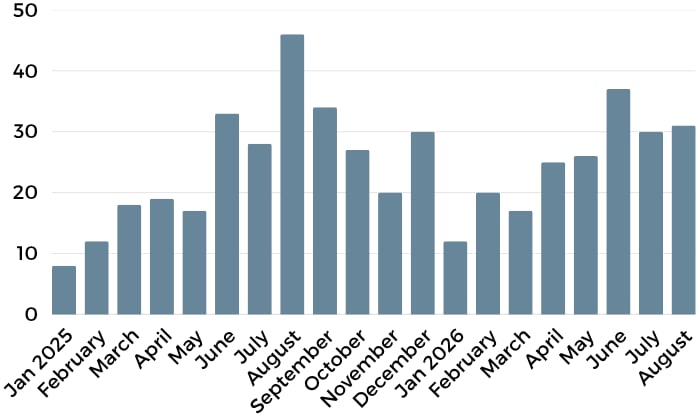
The year-over-year comparison tells a different story. August 2025 produced 46 sales, putting August 2026 approximately 33% behind last year’s pace.
That decline deserves attention, but it also requires context. The master data shows that the market entered August with 309 sales over the trailing 12 months, compared with 298 at the same point last year. In other words, August itself was substantially quieter, but the broader annual transaction pace remains healthy.
This is precisely why Incline Village and Crystal Bay can be difficult to interpret through a traditional monthly lens. Activty can surge one month, retreat the next, and accelerate again with remarkably little warning or obvious explanation.
Median Pricing Rebounds Sharply
August provided another perfect example of that volatility.
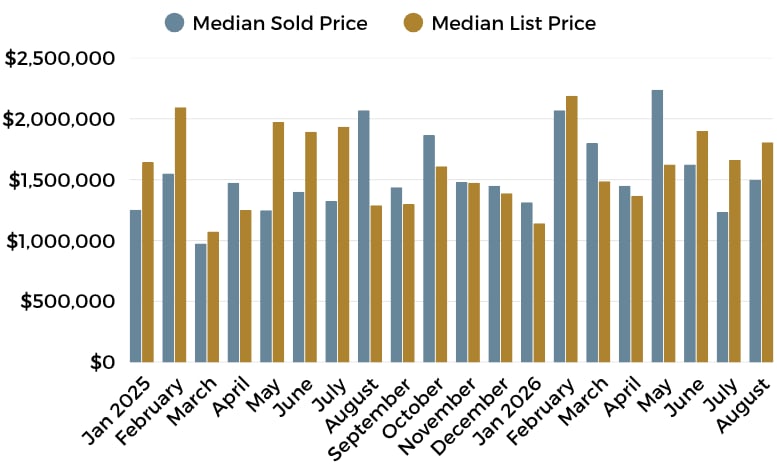
The median sold price climbed to $1,500,000, a notable 21% increase from July. Yet compared with August 2025, median pricing was approximately 28% lower.
How can prices simultaneously appear to be surging and falling?
The answer lies largely in the composition of sales. With only 31 transactions during the month, a handful of luxury closings, or their absence, can dramatically alter the median. This is particularly true in Incline Village and Crystal Bay, where the difference between an entry-level condominium and a premier lakefront estate can represent tens of millions of dollars.
Rather than reading too much into either comparison, the more meaningful takeaway is that pricing remains resilient despite slower transaction activity. Limited inventory continues to provide an important layer of support beneath the market.
Buyers Still Have Negotiating Power
August also reinforced the importance of thoughtful pricing.
Based on median list and sold prices, properties traded approximately 17% below asking, a considerable negotiating spread even though it improved from July’s roughly 26% gap.
This remains a market where buyers are willing to act, but increasingly unwilling to chase aspirational pricing. Sellers who align their expectations with current conditions can still generate meaningful interest, while properties positioned substantially ahead of the market may require patience and eventual adjustment.
For buyers, that creates opportunity. For sellers, it makes accurate pricing and property positioning increasingly important as the peak summer season winds down.
Inventory Remains the Bigger Story
Perhaps the most consequential trend continues to be supply.
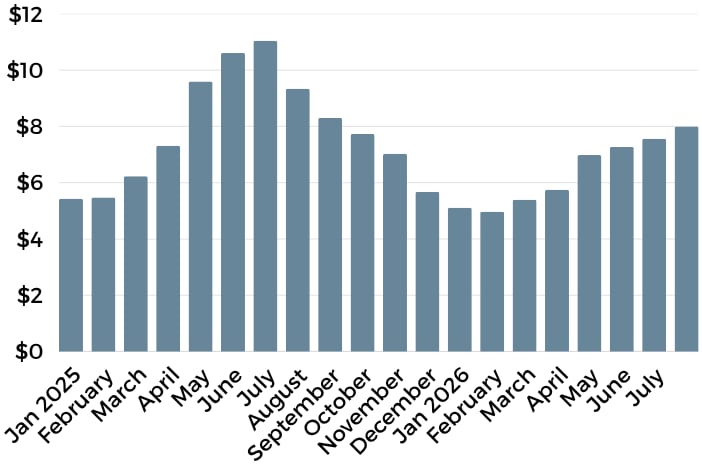
August ended with approximately 8.0 months of inventory, up only 6% from July. While that technically places the market in buyer-favorable territory by conventional real estate standards, Incline Village and Crystal Bay rarely fit neatly within conventional standards.
More important is the historical comparison.
August 2025 carried 9.34 months of inventory, meaning current supply is approximately 14% lower year over year. Go back another year and the contrast becomes even more pronounced: August 2024 reached approximately 10.95 months of inventory.
Across the summer months, inventory has averaged roughly 26% below last summer’s levels.
That is significant. Even with buyers negotiating aggressively and taking longer to make decisions, they simply have fewer properties from which to choose. That constrained supply is helping keep values sticky and preventing softer transaction activity from translating directly into widespread pricing deterioration.
Homes Are Taking Longer to Sell
One statistic that clearly moved in the buyer’s favor during August was marketing time.
Median Days on Market increased from 69 days in July to 98 days in August, compared with 85 days one year ago.
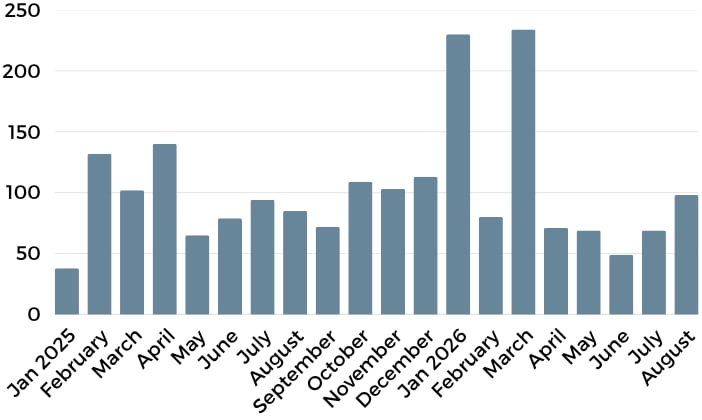
Unlike several of the other indicators, this one suggests buyers are exercising considerbly more patience. Properties are taking longer to find their eventual purchaser, reinforcing the importance of pricing correctly from the beginning.
Yet longer marketing periods are not particularly unusual in a luxury second-home market. Incline Village and Crystal Bay attract a narrower, highly discretionary buyer pool. Buyers rarely need to purchase here; they purchase because the right property, timing, lifestyle, and financial considerations align.
That distinction becomes increasingly important as we move toward fall.
Looking Ahead: Nevada’s Advantage Remains Powerful
As summer begins its sprint toward the finish line, the national economic backdrop remains complicated. Geopolitical tensions involving Iran and their potential effect on global energy markets remain an important variable. Sustained increases in oil prices could place renewed pressure on inflation, complicating the path toward lower borrowing costs and keeping financial markets sensitive to incoming economic data.
Yet Incline Village and Crystal Bay occupy an unusual position within that landscape.
This is not simply a Lake Tahoe housing market. It is also a Nevada residency market, and that distinction matters enormously.
Nevada’s lack of an individual state income tax continues to make Incline Village particularly compelling to affluent Californians seeking both a mountain lifestyle and a more favorable tax environment. For executives, entrepreneurs, investors, and business owners with flexibility over where they establish residency, the opportunity to live on Lake Tahoe while residing in Nevada creates a value proposition few luxury resort communities can replicate.
There is also another source of potential demand developing west of the Sierra. Years of extraordinary investment in artificial intelligence are increasingly translating into corporate earnings, rising valuations, liquidity events, and substantial wealth creation throughout Northern California’s technology ecosystem. Not every newly minted millionaire will buy a Tahoe home, of course, but history has shown that when Silicon Valley creates wealth, some of that capital inevitably finds its way east toward the lake.
And Incline Village may be uniquely positioned to capture it.
The next few months will undoubtedly bring more statistical twists. That is simply the personality of this market. One month can look sleepy, the next exuberant, and occasionally the numbers seem to change direction for no particularly satisfying reason.
But beneath that volatility, the fundamentals remain compelling: less inventory than recent summers, enduring out of state demand, Nevada’s powerful tax advantages, and an irreplaceable Lake Tahoe lifestyle.
Summer may be preparing to pack up the paddle boards, but Incline Village has never been particularly interested in following a predictable script. As we head toward fall, I wouldn’t be surprised if this market still has another plot twist waiting just around the shoreline.