A Seasonal Slowdown, But Prices Refuse to Follow
Fall has firmly settled into Truckee and North Lake Tahoe, bringing cooler temperatures, quieter streets, and the familiar seasonal slowdown in real estate activity. Yet October delivered an interesting contradiction: while home sales declined sharply, prices continued climbing, inventory tightened, and properties sold considerably faster than they did one year ago.
For those watching only transaction counts, October might suggest a weakening market. Look a little closer, however, and the story becomes far more compelling. The Truckee–North Lake Tahoe market continues to demonstrate remarkable pricing resilience, supported by constrained inventory, desirable lifestyle communities, and buyers who remain willing to act when the right property becomes available.
As we enter the final stretch of 2026, the distinction between a slowing market and a seasonal slowdown has rarely been more important.
Sales Retreat as the Market Enters Its Quieter Season
October concluded with 92 closed sales, a substantial 31% decline from September's 133 transactions. Compared with October 2025, when 132 homes changed hands, sales were approximately 30% lower year over year.
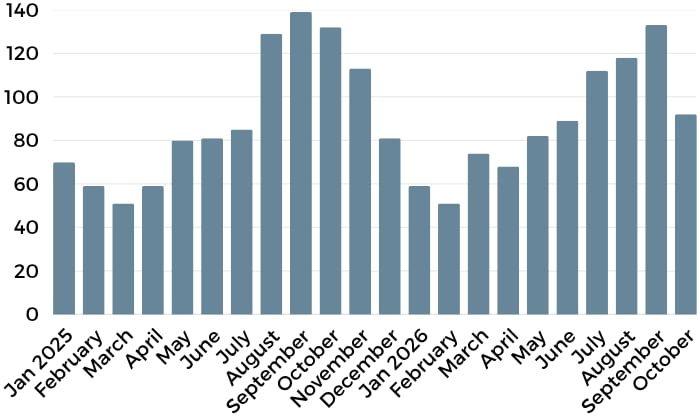
While those declines are significant, the month-over-month retreat is consistent with Tahoe's traditional seasonal rhythm. September frequently captures the final wave of summer transactions, while October marks the transition toward slower fall and winter activity.
The year-over-year decline deserves closer attention, particularly given that October 2025 maintined unusually strong transaction volume. However, fewer sales do not automatically translate into weakening property values, especially in a market where available inventory remains relatively constrained.
Median Prices Continue Defying Expectations
Perhaps October's most compelling statistic was pricing.
The median sold price climbed to $1,330,000, a 7.3% increase from September's $1,240,000. Even more impressive, the median price finished approximately 21% above October 2025, when it stood at $1,100,000.
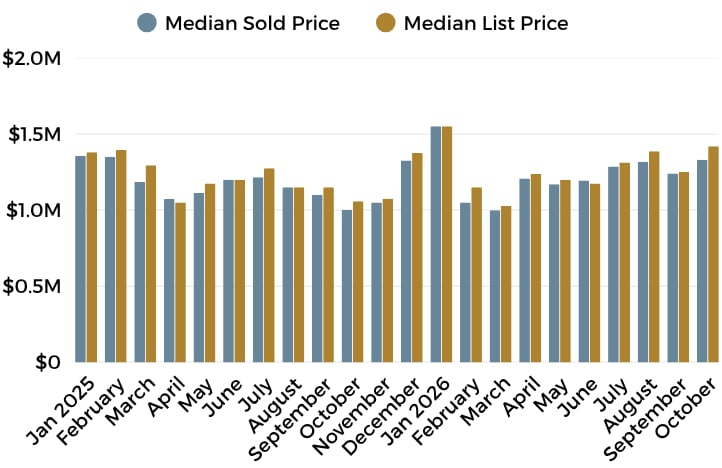
That is a remarkable year-over-year increase, particularly during a month when transaction activity declined substantially.
Some of this movement may reflect the composition of homes sold, particularly when higher-priced properties represent a greater share of monthly closings. Nevertheless, the broader trend remains encouraging: pricing continues to demonstrate resilience despite elevated borrowing costs and a more selective buyer pool.
Negotiations did loosen somewhat, with properties trading at approximately 94% of asking price, representing an average discount of roughly 6%. Buyers are clearly exercising greater discipline, but sellers with desirable, appropriately priced properties continue to find opportunities.
Inventory Continues Its Seasonal Decline
Available inventory declined to 4.11 months of supply, down from 4.47 months in September and slightly below the 4.20 months recorded in October 2025.
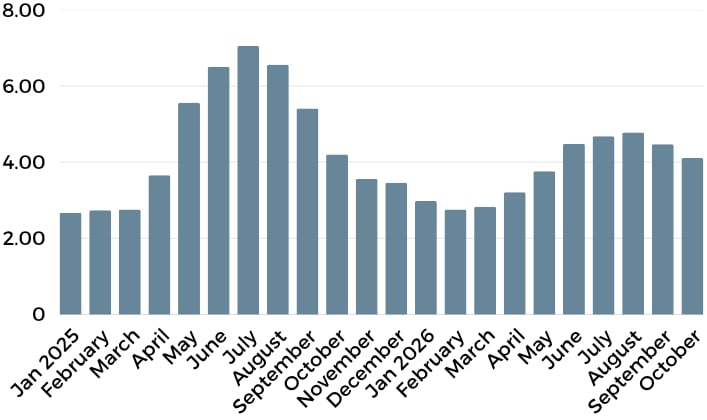
This contraction is consistent with Tahoe's historical seasonal pattern. As winter approaches, fewer homeowners introduce new listings, while some existing sellers elect to withdraw their properties until spring.
The result is a market where buyers may face increasingly limited choices, even as overall transaction activity slows.
Interestingly, October's inventory levels are now only modestly below last year's, suggesting that the substantial supply imbalance observed throughout the summer may be gradually normalizing. Still, approximately four months of inventory represents a relatively constrained marketplace by historical standards.
For sellers, limited competition can be advantageous. For buyers, the quieter winter months may offer additional negotiating opportunities, although finding the right property can become increasingly challenging.
Homes Continue Selling Significantly Faster
Median Days on Market declined slightly to 27 days in October, compared with 29 days in September.
The more revealing comparison is year over year.
In October 2025, homes spent a median 54 days on market, meaning properties this October sold in approximately half the time.
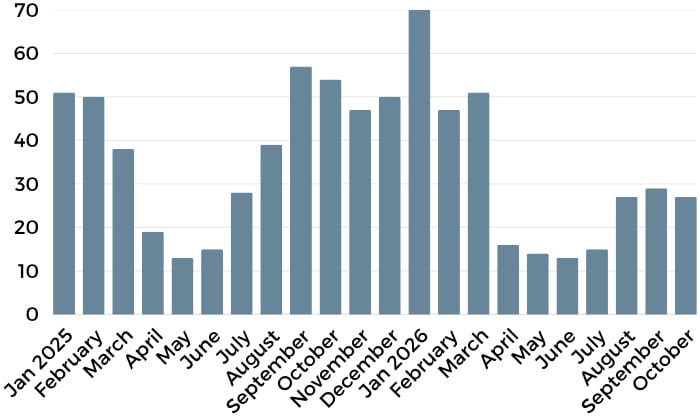
That is particularly noteworthy given the sharp decline in transaction volume.
While fewer homes are changing hands, those that do sell are finding buyers considerably faster than they did last fall. This suggests that well-positioned properties continue attracting motivated purchasers, even as the broader market becomes more deliberate.
The takeaway is straightforward: buyers remain engaged, but pricng, presentation, and property quality matter more than ever.
Looking Ahead: A New Political Landscape and Tahoe's Next Wave of Wealth
As we approach the final months of 2026, the national economic landscape may be entering an important turning point.
November's midterm elections delivered a decisive shift in Washington, with Democrats winning control of both chambers of Congress. Financial markets responded enthusiastically, with the Dow Jones Industrial Average surging more than 1,500 points following the results. Investors appear increasingly optimistic that a divided government could encourage a more measured approach to fiscal policy and potentially accelerate efforts to de-escalate the conflict involving Iran.
That possibility carries meaningful implications for real estate. The war has contributed to elevated global energy prices, renewed inflationary pressures, and higher Treasury yields, which helped push average 30-year mortgage rates above 7% during October. Should geopolitical tensions ease and oil prices continue declining, inflationary pressures could moderate, potentially creating a more favorable borrowing environment heading into 2027.
Of course, lower oil prices do not automatically translate into lower mortgage rates, and the Federal Reserve still faces difficult decisions. Nevertheless, the prospect of greater geopolitical stability offers a welcome reason for cautious optimism.
Closer to home, another economic force continues gathering momentum: artificial intelligence and the extraordinary wealth being created throughout Northern California's technology sector.
AI investment remains a powerful driver of corporate spending, valuations, and capital formation. Anecdotally, Bay Area real estate professionals are beginning to report increased purchasing activity tied to newly realized technology wealth. While it is too early to quantify the impact on Tahoe, the potential implications are significant.
Historically, when Silicon Valley creates substantial wealth, some of that capital eventually makes its way east over the Sierra Nevada. Whether through company liquidity events, equity compensation, or entrepreneurial success, newly affluent buyers frequently look toward Tahoe for second homes, recreational retreats, and long-term family investments.
If that emerging wealth translates into measurable additional demand while local inventory remains constrained, it could provide another meaningful tailwind for property values throughout Truckee and North Lake Tahoe.
For now, October's numbers reinforce an important message: seasonal slowing does not necessarily mean market weakness. Prices remain elevated, homes are selling faster than last year, and inventory continues its familiar retreat toward winter.
The paddleboards have been packed away, the mountain bikes are getting their final rides, and snow forecasts are beginning to replace lake temperatures in everyday conversation. Tahoe may be settling into its quieter season, but the real estate market still has plenty of life beneath the surface.
And with a new political landscape, evolving economic conditions, and potentially another wave of Bay Area wealth on the horizon, 2027 could prove to be a particularly interesting year in the mountains.
After all, Tahoe has always had a way of rewarding those who look beyond the season and toward the bigger picture.